
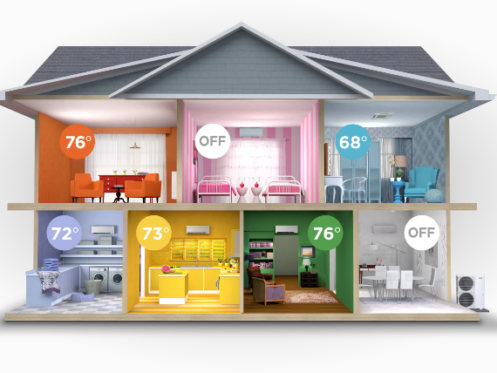
If you have a two-story home with one HVAC system, you already know the problem: the upstairs is always too hot in the summer and the thermostat is downstairs. You crank the AC to cool the bedrooms and now the living room feels like a freezer. HVAC zoning is designed to fix exactly this. It gives you independent temperature control for different areas of your home so you are not fighting the thermostat all day.
How Does HVAC Zoning Work?
There are two main approaches to zoning: ducted and ductless. The right one depends on your home, your budget, and what you are trying to accomplish.
Ducted Zoning
This is the most common setup we install, especially on two-story homes with a single system. Motorized dampers go inside your existing ductwork and open or close based on which zone is calling for heating or cooling. Each zone gets its own thermostat, so your upstairs and downstairs can run at different temperatures independently.
Here is the part most blogs will not tell you: the equipment matters just as much as the dampers. When zones close off, you are reducing the amount of ductwork the system pushes air through. If your furnace or air handler is a single-stage unit (meaning it only runs at full blast or not at all), you end up with way too much airflow being forced through half the ducts. That creates high static pressure, which is hard on the equipment and hard on your comfort.
This is actually a huge problem in our area. For decades, homebuilders have been installing single-stage systems on zoned ductwork in new construction. It might save money upfront, but it kills equipment life and efficiency. High static pressure leads to early breakdowns, and in some cases, cracked heat exchangers. That is not a cheap fix.
When we install or replace a zoned system, the furnace needs to be at least a two-stage unit. A two-stage (or variable-speed) system can ramp down when only one zone is calling, which keeps static pressure in check and the system running the way it should. If someone is quoting you zoning with a single-stage system, that should be a red flag.
Ductless Mini Splits
Ductless mini splits are another way to get zoned comfort, and they are one of the most popular upgrades we do. The most common scenario is adding a single indoor unit to one problem room. Think of the bonus room over the garage that is always 10 degrees hotter than the rest of the house, or a master bedroom that never quite gets comfortable. A single-head mini split solves that without touching your existing system.
Whole-home ductless systems (with an indoor unit in every room) can work well in smaller homes. But in a lot of the larger tract homes in our area, they are not always the best fit. The cost adds up quickly with multiple heads, and the reality is most homeowners do not want to manage the temperature in every single room individually. When heads get left on or off at the wrong times, you can actually end up with more hot and cold spots than you started with.
For most of our customers, the sweet spot is keeping their ducted system for whole-home comfort and adding a mini split where they need a little extra help.
What Are the Benefits of HVAC Zoning?
The biggest benefit is pretty simple: comfort where you want it, when you want it. But there are a few other things worth mentioning.
Even Temperatures Throughout the Home
Two-story homes almost always have a temperature difference between floors. Heat rises, cold air sinks, and a single thermostat cannot account for both. Zoning lets you treat each floor (or area) separately so the whole home stays comfortable.
Energy Savings
When you are not blasting conditioned air into rooms nobody is using, your system does not have to work as hard. Zoning lets you dial back areas like guest rooms or upstairs during the day while keeping the main living spaces comfortable. How much you save depends on how you use it, but the potential is there.
Less Wear on Your Equipment
This one comes with a big asterisk: you only get this benefit if the system is set up correctly. A properly staged system with zoning will run more efficiently and put less stress on components. A single-stage system on zoning does the opposite. Setup matters.
How Do I Know if My Home Needs Zoning?
Here are some of the most common situations where zoning makes sense:
- You have a two-story home with one system and the upstairs is always warmer
- There is a bonus room or addition that never gets comfortable
- You have rooms with a lot of windows or sun exposure that heat up during the day
- Family members have very different temperature preferences
- Parts of your home sit empty most of the day
If any of that sounds familiar, zoning is probably worth looking into. And if you already have a zoned system with a single-stage furnace that seems to break down a lot, that static pressure issue we talked about could be the reason.
What Does Installation Look Like?
For ducted zoning, we install motorized dampers in the ductwork, add a zone control panel, and put thermostats in each zone. The most important part of the job is making sure the equipment can handle it. If the existing furnace is single-stage, we will talk through your options for upgrading to at least a two-stage unit before adding zoning.
For a mini split addition, installation is straightforward. We mount the indoor unit, connect it to an outdoor condenser, and run the refrigerant lines. Most single-room installs can be done in a day.
Schedule Your Zoning Consultation
Greiner Heating, Air and Electric installs ducted zoning systems and ductless mini splits throughout Natomas, West Sacramento, Davis, Dixon, Woodland, Winters, Rio Vista, Vacaville, Fairfield, Suisun, and Benicia. Whether you need to tame a hot upstairs, add comfort to a bonus room, or replace a zoned system that was set up wrong from day one, we can help you figure out the right approach.
Give us a call to set up a consultation.
